 | |
| |
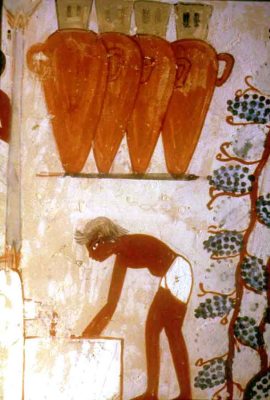 |
Red wine was very common and it is said that sweet wines have a high alcohol content. Tomb paintings give a look at the ancient wine cellars where amphorae were stacked in rows on shelves, some of the more famous vinyards were “The Phoenix Estate on the Horizon of Kemet in the Sile district, The vinyard Ways of Horus in the Lake Menzalah district, The Preserver of Kemet in the Tanis/Pi-Ramesses district and Estates on the western river. On the canopic branch of the Nile, and highly thought of, this wine was found in cellars in the palace of Amenophis II at Thebes and Armarna. Egypt exported her wine all over the ancient world, including to Rome a country rich in it’s own vinyards. Apparently, Romans most appreciated the wines produced in Lake Menzalah, Tanis, northern Xois and the region of Sile.
There were many gods and goddesses associated with wine. Osiris was honored at the Quag festival, the hieroglyphics making up the name of the festival include three jars on a table and another being offered by and outstretched hand. The goddess Renentet had the distinction of having a small shrine near the wine press and vat as well as on the spout where the wine poured from the vat into the receiving tank. Invocations were also made to Imsety (Amset, Mestha) god of the deceased’s liver. Shezmu, however, is a patron deity of wine and unguent-oil presses. He is mostly depicted in anthropomorphic form as the master of a (wine)press. He has a dual personality with ability to be both beneficient and cruel: On the cruel side he is known from the Old Kingdom to the Roman days. In the well known 'Cannibal Hymn', Pyramid Text 403 it is Shezmu who butchers and prepares the gods themselves for the king to absorb extra divine strength. He is also the one who brings the king grape juice for wine production. In the Coffin Texts from the Middle Kingdom, he is the demon who squeezes heads like grapes and lassoes sinners to the slaughter-block. In the Book of Going Forth By Day, Shezmu is associated with the capture of beings in the afterlife. In a papyrus from the New Kingdom (Dyn 21) his cruel aspect is shown as two hawk deities wringing the net of the wine press but instead of grapes it contains three human heads. In time, his benign aspect became more emphasized and in the Book of Going Forth By Day says: 'Shezmu is with you, he gives you the best of the fowl'. In the New Kingdom he comes forward as a god producing perfumes and fragrant oils for the gods and on the sarcophagus of Ankhnesneferibre, Gods Wife of Amun, Shezmu is describe as maker of prize quality oil to Re. In the Graeco-Roman Period, the benevolent aspect became the one most emphasized. |
| |
Written by Hilarity Hatshepsut with assistance from Sankira Qin. Site design by Sankira Qin. The authors wish to gratefully acknowledge MerytMaihes Osorkon, Sementawy Horemheb, Menes Mentuhotep, Marduk Hammurabi, Asenath Amenhotep, Mirjam Nebet, Shesmu Ramesses, and Kaz Matsudaira for their research and graphics assistance. | |