 | |
| |
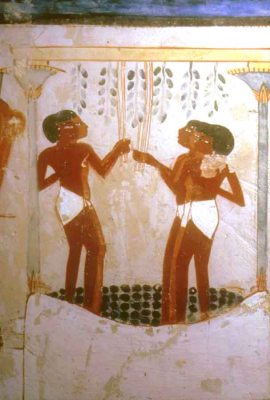 |
Harvest occurred in late summer (August) without tools and mainly by men. The grapes were handpicked and put into large baskets that were carried on the head, the shoulders, or put into a yoke, they were then emptied into vats that were large enough for six men who stomped the grapes with their feet.
The juice flowed through a hole in the side of the vat into a smaller vat and was poured into pottery jars to ferment. Secondary pressing was done to separate the juice from the stems, seeds and skin, then the juice was put into a sack and stretched, either on a frame with a pole at one end or between two poles, the poles were twisted to extract the juice that was then put into a large container. The wine was fermented in open containers then was racked and put into smaller containers and were sealed with rush bung stoppers and covered with mud capsules; small holes were left in the stoppers that allowed the carbon dioxide that occurred in the secondary fermentation to escape. When fermentation was complete the holes were sealed. At times the wine was strained before drunk, other times it would be siphoned to prevent the dregs from mixing with the wine that was to be poured.The wine vessels were labeled much like wine today with information such as the name of the vinyard, location, year, the vintner and the quality. There were three different grades of quality: good (nfr), twice good (nfr nfr), and three times good (nfr nfr nfr), which was considered the finest. Another way of grading was genuine, sweet, merrymaking (not too good) and blended. It was important to list the vintner’s name so that if the vintner moved to another location his customer’s would know where to find him. At times wine was enhanced by mixing it with other wines or adding herbs and other flavorings. It is possible that honey was added to wine to give it a sweet flavor. Although most people think of wine being synonymous with grapes, the Egyptian’s had five different types of wine: grape, pomegranate, date, fig, palm and other sweet fruits. Palm wine was made by tapping on the trunk of the tree close to it’s branches, the juice was collected and left to ferment. Date wine was made by crushing the dates, collecting the juice and allowed to ferment. A friend of Sementawy Horemheb has this to say about Pomegranate wine, “I have tasted a bottle of pomegranate wine (of recent vintage), and find that it has a fruity, sweet taste no unlike many 'blush' wines made today.” |
| |
Written by Hilarity Hatshepsut with assistance from Sankira Qin. Site design by Sankira Qin. The authors wish to gratefully acknowledge MerytMaihes Osorkon, Sementawy Horemheb, Menes Mentuhotep, Marduk Hammurabi, Asenath Amenhotep, Mirjam Nebet, Shesmu Ramesses, and Kaz Matsudaira for their research and graphics assistance. | |