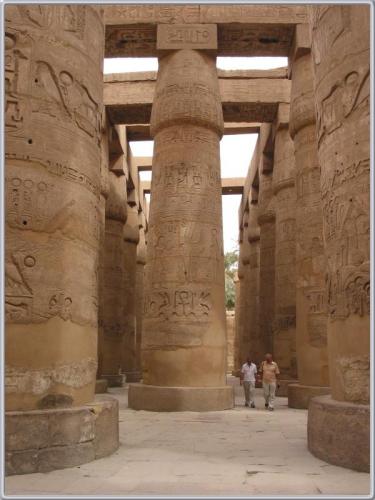
While you are enjoying the columns of the Hypostyle Hall don't forget to look up. There are many decorative features and sacred inscriptions on the columns and arches that you might miss otherwise. For example, this one. But perhaps a little explanation is in order.
 The emblem to the far left of this inscription is one I'm sure you've all seen. Its fame has spread throughout the world. This is the symbol for the word ankh which means life. Moving from left to right, the next symbol — the sedge (or bullrush) — symbolizes Upper Egypt. The bee next to it is the symbol for Lower Egypt. Together they mean "King of the Two Lands."
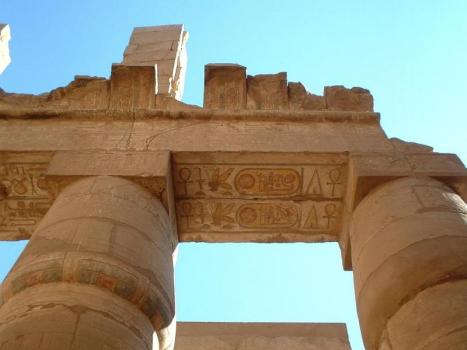 |
The king's name is enclosed within a shenou or cartouche. Here the king referenced is User-Ma'at-Ra setep-en-Ra, the coronation name of Pharaoh Ramses II. And finally, to the right of the king's shenou is a conical loaf and another ankh. These two emblems placed together read di ankh which means "given life".
The inscription reads, Ankh nsw-byt Usr-ma'at-Ra stp-n-Ra di ankh ** — literally, "Life to the King of the Two Lands, Usr-ma'at-Ra stp-n-Ra! May he be given life!" [I think the Celts or one of those Britannic races put it, "Long live the king!"] The entire inscription is a magical incantation to insure immortality to the Pharaoh Ramses.
 ** Ankh neh-soo-beet oo-ser-muh-aht-rah seh-tehp-en-rah dee ankh


